

Click, and the world changes. It changes when the viewpoint becomes shared, and we stand on the side of the other, the next being the animal world. Images of animals, but not only. Photographs were taken with an animal mindset, skillfully chosen by Jo-Anne McArthur, a Canadian photographer who was the guest of guests, as documented by the VeganOK TgNews VeganFest Special, created by Francesca Ricci, reporting the exclusive participation of the world’s most beloved photographer among animal rights activists in Bologna. Interviewing the lens that speaks most about the animal planet and its fate were Renata Balducci, president of the Associazione Vegani Italiani Onlus AssoVegan, and Davide Turrini, a colleague from Fattoquotidiano.it.
The book recounts 15 years of work. How did it start?
“The project began with curiosity, love for animals, and concern for their welfare, as I am an animal rights activist myself. Usually, many images are taken, but not of the animals ‘beyond the wall’ where they are used to become food. There were no images of this transition…”
The volume’s introduction reads: “The book is organized into five sections, three examining animal exploitation, one celebrating animal rescuers and shelters, and one a snapshot of diaries from 2009 to 2013. Finally, a handy list of sources to end animal suffering.” Furthermore, it states: “I have always provided context along with the photographs with specifics on the animal, and the industry mentioned, to give you an idea of the sounds and smells found behind the images.”
Making sounds and smells felt: it’s a compelling project that this book manages to communicate! How did you achieve this?
“I studied English literature at university, wanting to become a writer. Well, when I found myself describing these gruesome images, I made the mistake of telling the reader how terrible what I was depicting was. Then, the publisher suggested changing the writing to specify sounds and smells instead, leaving the conclusions to the reader and the observer. The impact was much stronger then.”
The photo captures both beauty and its opposite, disturbance…
“When you see gruesome images, you’re inclined not to look, to turn away. In my photos, I’ve decided to show and not show. There’s a more complex element, there are more nuances. That’s why you don’t turn away, even if they are violent and gruesome. You look more, you enter into the photo.”

Can you tell us how you got started as a photographer?
“It all started with my dad’s Minolta; I always had it with me. I didn’t think of it as a profession; I thought photographers were all men of a certain age. But then, I had a magical encounter at the university’s black-and-white printing course. From there, I understood that photography would be my profession, that it would be my life. The camera is an exceptional tool for relating to people; it opens doors.”
Your next work will be on female animal activists on the front lines. They make up 78% of volunteers.
“It’s a celebration of women’s work for animals. The project is called “Unchained.” About 80% of activists worldwide are women who started the animal rights movement. This deserves to be celebrated, to bring to light the work done, and to reward their commitment. I want to bring joy and positivity to following the work of women who follow animals. We are still collecting material. That is one of the rare sectors where women are at the forefront.”

The part related to bullfighting, to the figure of the bull, shows different contexts: the French and the Spanish. There is a photo of a child training to become a bullfighter. When asked why he does it, he replies, “Because I love bulls.” Loving animals in this way is a cultural aberration—to love to kill them!
“Exactly! Reading the text illuminates the meaning of the photo. Children’s innocence does not know how we treat bulls; this is what emerges!”
Among all the places you visited, which has marked you the most?
“The worst places are perhaps intensive farms where cruelty is palpable. But the image that has stayed with me the most is that of a little fish. I met the owner, who kept it in a glass of water. It was lying on the bottom, motionless. It’s dying, I said. And she replied: “No, it’s been like this for two years.” In this glass, there was nothing… See, you don’t need to go to an intensive farm to discover such things. Cruelty is everywhere, and at an individual level, we find these things. That’s why we need to open our eyes, to make them open because only then will there be change.”
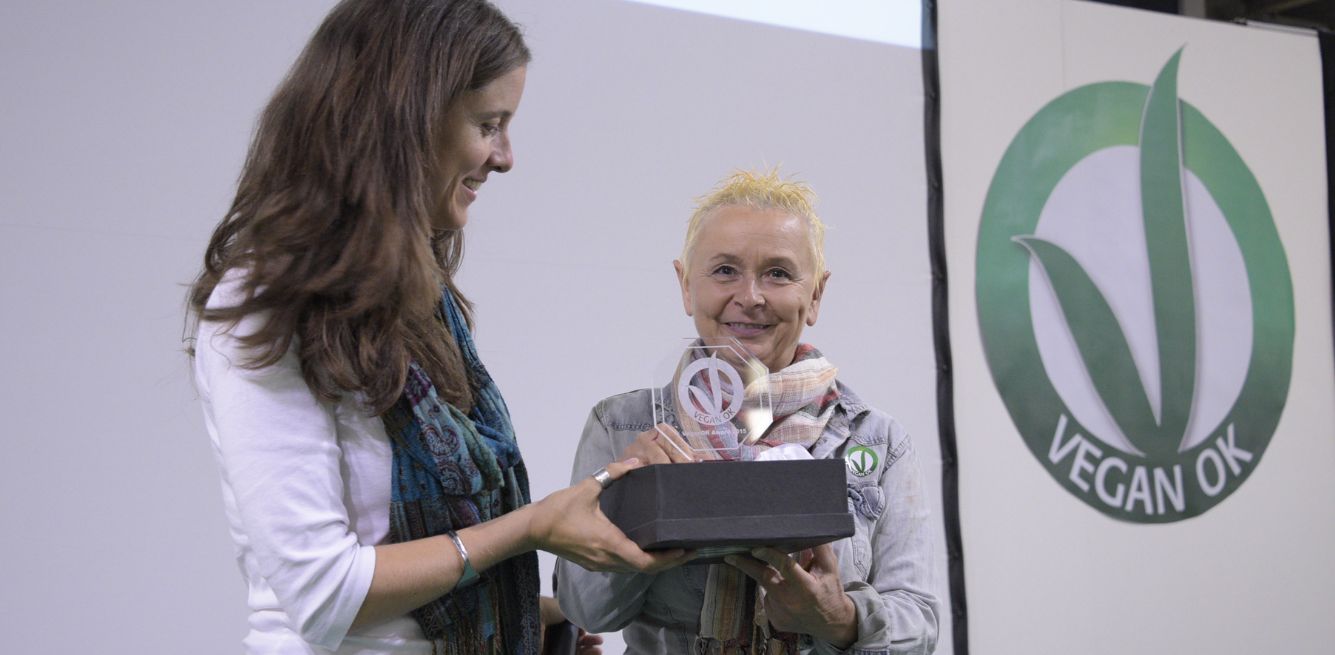
 At the end of the interview, Renata Balducci presented Jo-Anne McArthur with the VeganOK Animal Guardian Award 2015 and the honorary membership card of the Associazione Vegani Italiani Onlus.
Renata Balducci finally focused on an image from the book, that of the destroyed laboratory: “It’s a photo that tells of hope; we hope that tomorrow these realities will be rubble.” The photos are freely available for animal rights associations’ campaigns.
And here is the reason for the award:
“To Jo-Anne McArthur, Canadian photographer, for having so profoundly represented through photographic image the suffering, humiliation, and absence of recognized rights of our non-human brothers. For this, we confer upon her the VeganOK Animal Guardian 2015 award.”
See the report:
In short: